
Five Must-Have Africa Twin Upgrades
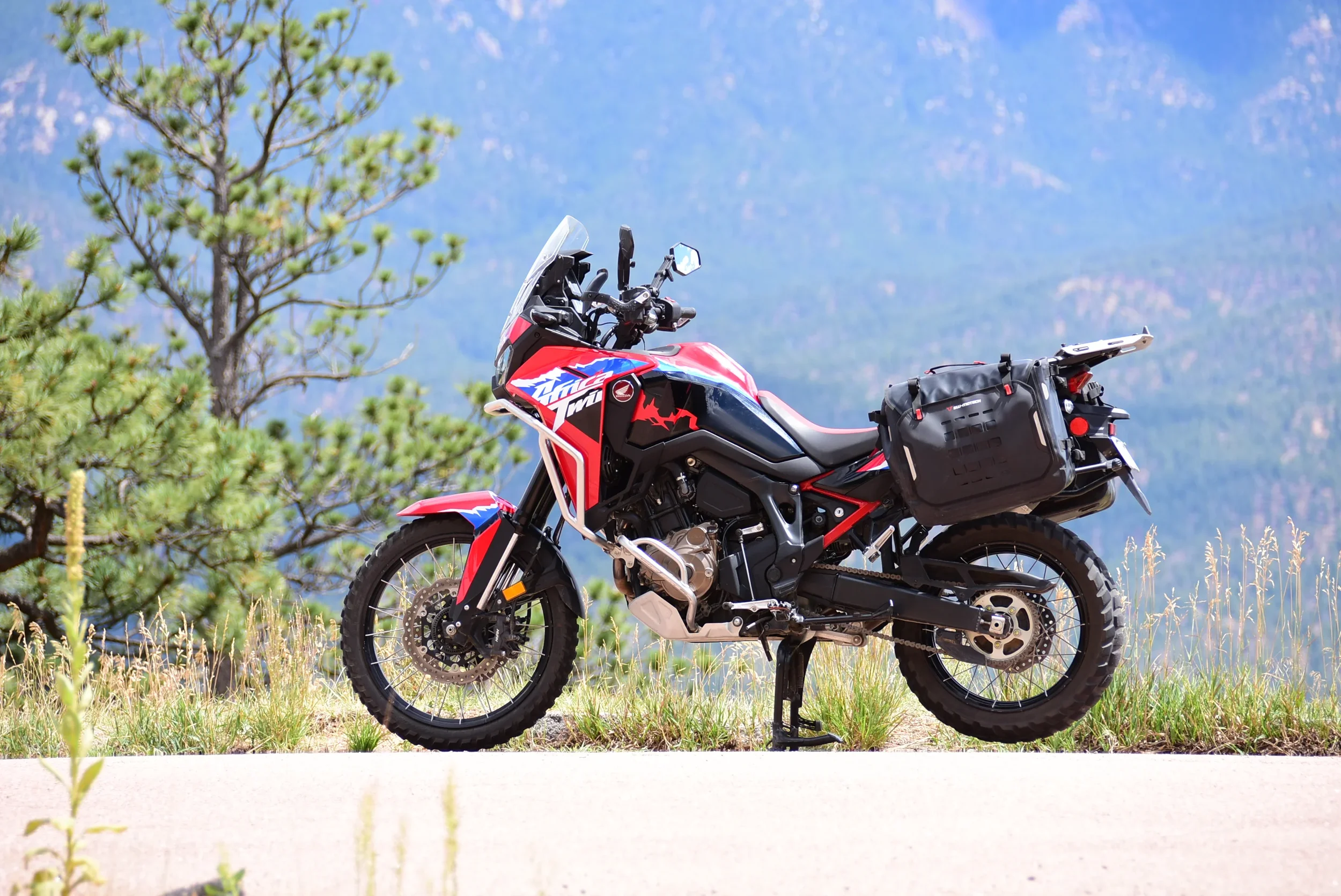
One of the best values in the adventure motorcycle category has to be Honda’s Africa Twin. In 2026, there are four available trim levels starting with the manual transmission base model at $15,199, a DCT version of the same bike at $15,999, and then a pair of Adventure Sports ES models (with more road-oriented wheel sizes, large fuel capacity, and electronic suspension): $17,799 standard and $18,599 with DCT. And while all four machines come with a lot of standard features, there are some key ADV ingredients that are missing if you plan to spend a lot of time off highway, or doing on-highway touring.
The reality is that with a few smart additions, you can outfit the Africa Twin to be exactly the machine you need it to be, while saving a massive amount of money compared to top-of-the line European ADVs. Here are five suggestions that we’ve added to our 2024 manual transmission base model that didn’t break the bank, but added the functionality we were looking for.
The first thing that any owner of an adventure bike who is planning to purchase aftermarket parts must consider, is what are you going to do with the bike and where do you plan to ride it. With this build, we tried to improve its off-highway capabilities, but also make it more capable for touring (on-road or off).
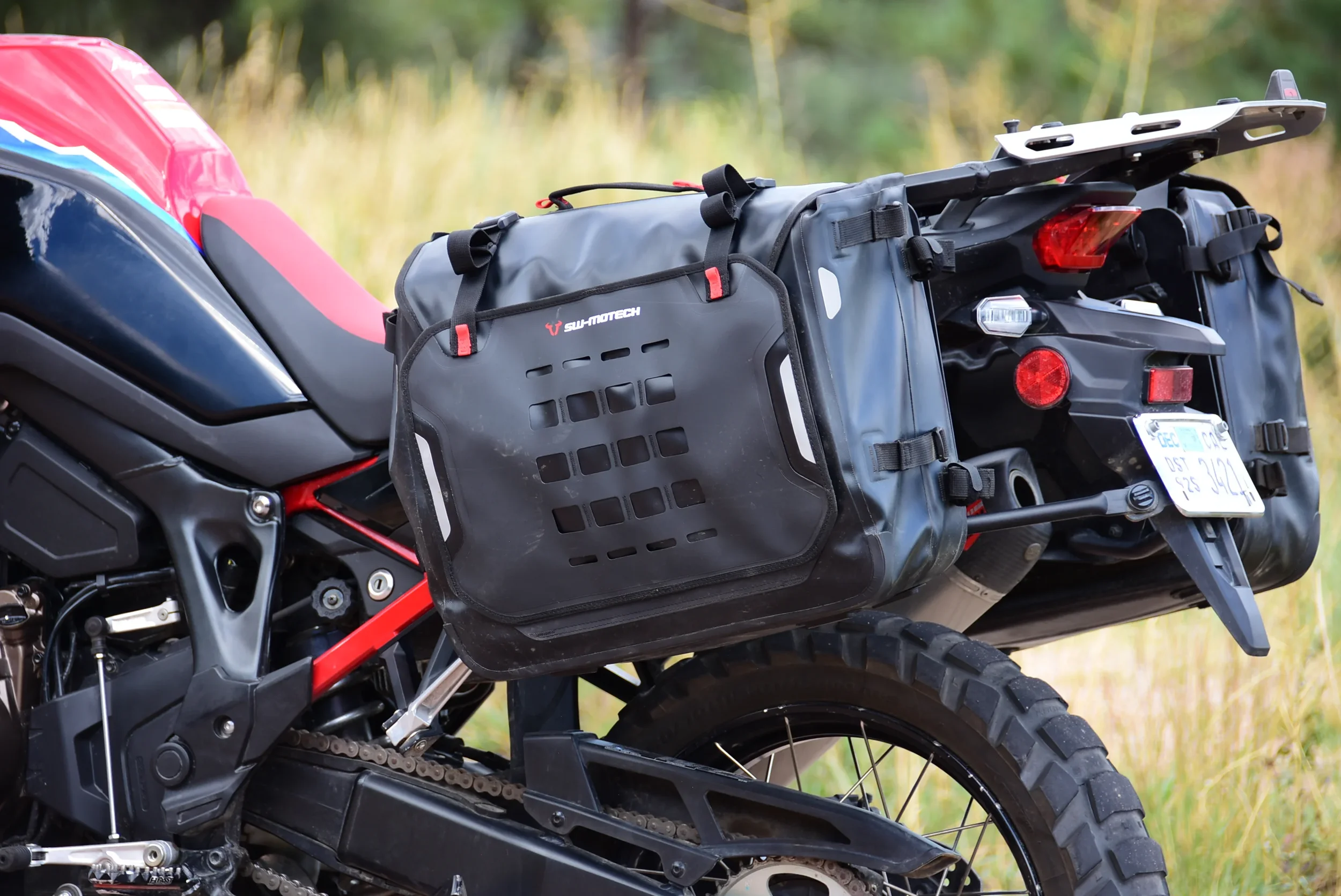
The SW-Motech SysBag WP Saddlebags are soft bags with a rigid backing plate that helps them retain their shape. Inside is an adjustable and removal inner bag that is concealed by a waterproof roll-top closure.
Pack It In, Pack It Out
One of the first things that needed to be addressed was luggage. Honda offers multiple hard pannier options in its accessory catalog, but we wanted to go the soft luggage route. We opted for the SW-Motech SysBag WP Saddlebags. Our criteria focused on versatility, durability, and ease of use. The SysBag system uses a rigid backplate to help the bags retain their shape, and utilizes a waterproof roll-top inner closure and two-buckle outer flap made of a more durable material. These bags have proven to be extremely functional in a wide variety of situations. They are easy to organize with their removable, adjustable, three-compartment inner bags. They have never failed keeping the contents dry, even in torrential rain. Taking the bags on and off only requires pressing a single button to release the cam-lock on the rigid mounts that they attach to, which has made unloading after a long day quick and simple. At $1140 (including mounts and all hardware), the system is comparably priced to Honda’s accessory hard luggage. The SW-Motech system has proven to be durable, functional, and easy to use.
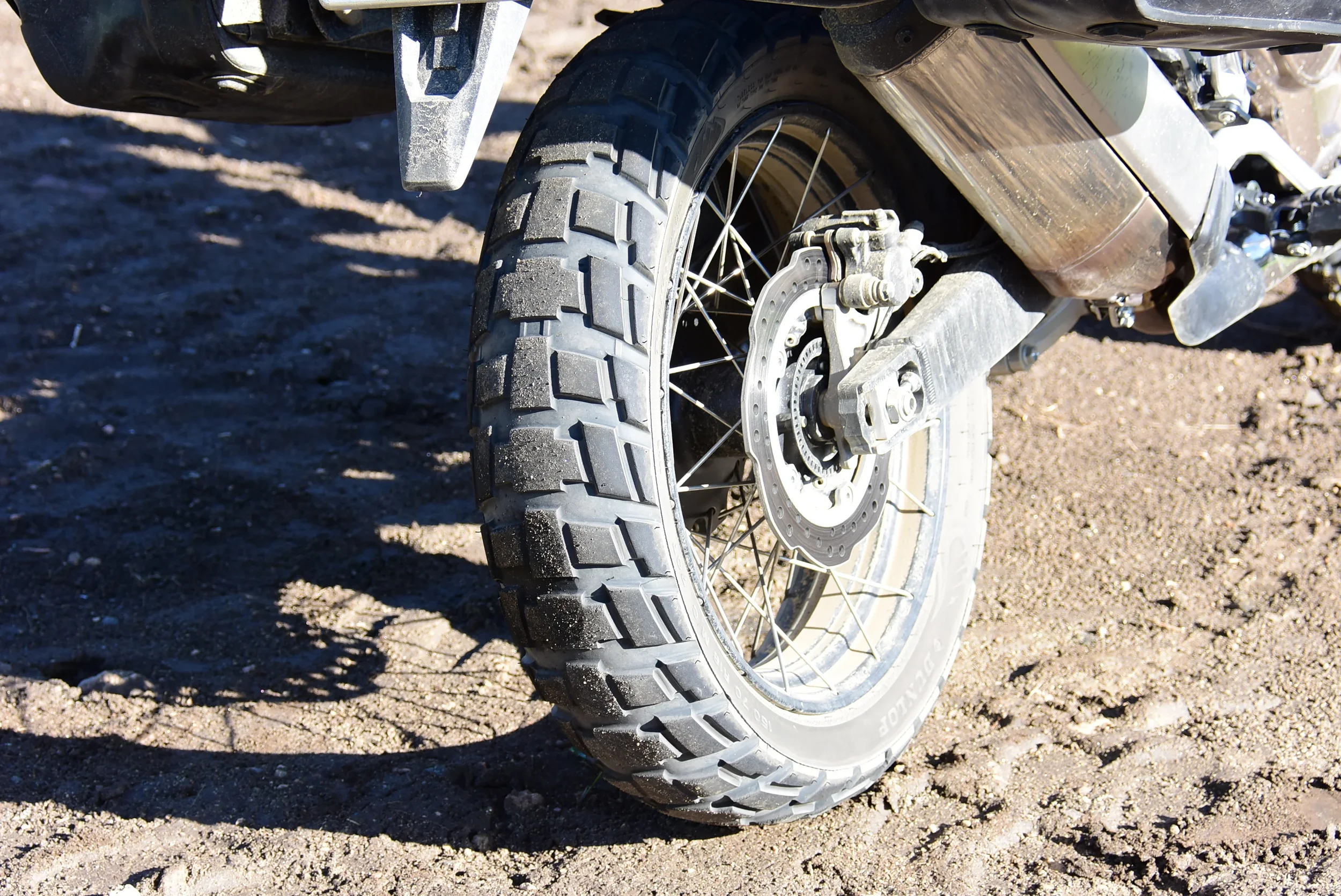
Dunlop’s Trailmax Raid has proven to be the best all-around choice for this bike. It’s really good off the highway in the dirt, and excellent on the asphalt.
Get A Grip
If off-highway riding is on your agenda, then the tires that come standard on the Africa Twin aren’t going to cut it. Our bike came with Michelin Anakee Adventure tires, which are more of an 80/20 (road/dirt) option. Over the past 8000 miles we’ve tried two other options: Dunlop’s Trailmax Raid (90/90-21, $172; 150/70-18, $285), and Metzeler’s Karoo 4 (90/90/21, $144 ; 150/70-18, $255). These choices were meant to fill two somewhat different roles: the Dunlops for lighter duty off road and on-road performance, and the Karoos for off-road use including sandy and muddy trails and two-track. Both sets of tires fulfilled our requirements perfectly.
The Trailmax Raid is a very impressive tire, it proved to be far better on dirt forest roads than we expected, offering really good traction for acceleration and braking, while providing enough knobs on the edge for good confidence while cornering. But perhaps its best attribute is how good it was on the pavement, providing exceptional grip in all on-road conditions—far exceeding the performance of the stock tires. Another unexpected attribute was when we were running lower tire pressures for the dirt, it barely affected performance when we jumped back on the pavement.
On the other side of the spectrum is the Metzeler Karoo 4. This tire has a classic ADV large block pattern that offers excellent off-road grip without feeling squirmy on the pavement. For extended off-highway riding, we typically lowered the tire pressures to 25 psi front and rear. The grip and confidence that the Karoos provided on loose and sandy roads was exceptional, giving us the confidence to charge into corners with much more speed than we’d ever dare on the stock rubber. There is a payoff, however, with far less mileage (especially the rear) than the Dunlops or stock tire. But if you want the ultimate grip off road, that’s the price you’ll have to pay. After 1500 miles the rear is starting to look like it is at its half life.
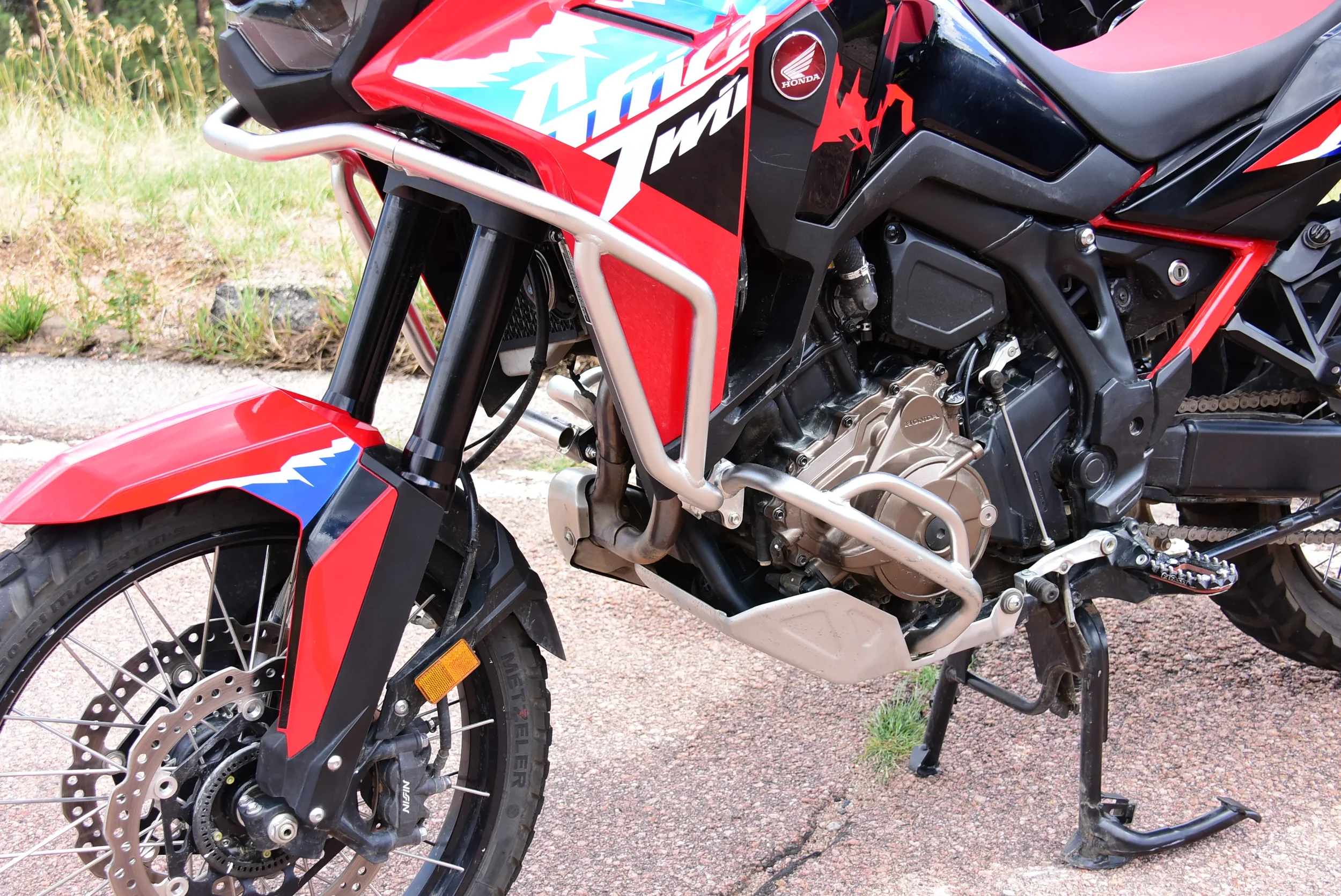
For crash protection we opted for Honda’s accessory Upper Fairing Guards, and Engine Guards.
Tipovers Don’t Have To Hurt (your bike)
Tipovers are very likely off highway, and the Africa Twin only comes with minimal protection in the form of a skidplate. There are a ton of aftermarket options for bike protection, but we decided to give the Honda accessory upper fairing guards ($474) and engine guards ($226) a try, as they are affordable and we knew they would fit without any issues. Installing these pieces took a bit more time than expected, but once in place felt rigid and sturdy and immediately did their job when a slipped foot off road caused a minor tipover that ended up causing zero damage to the bike.
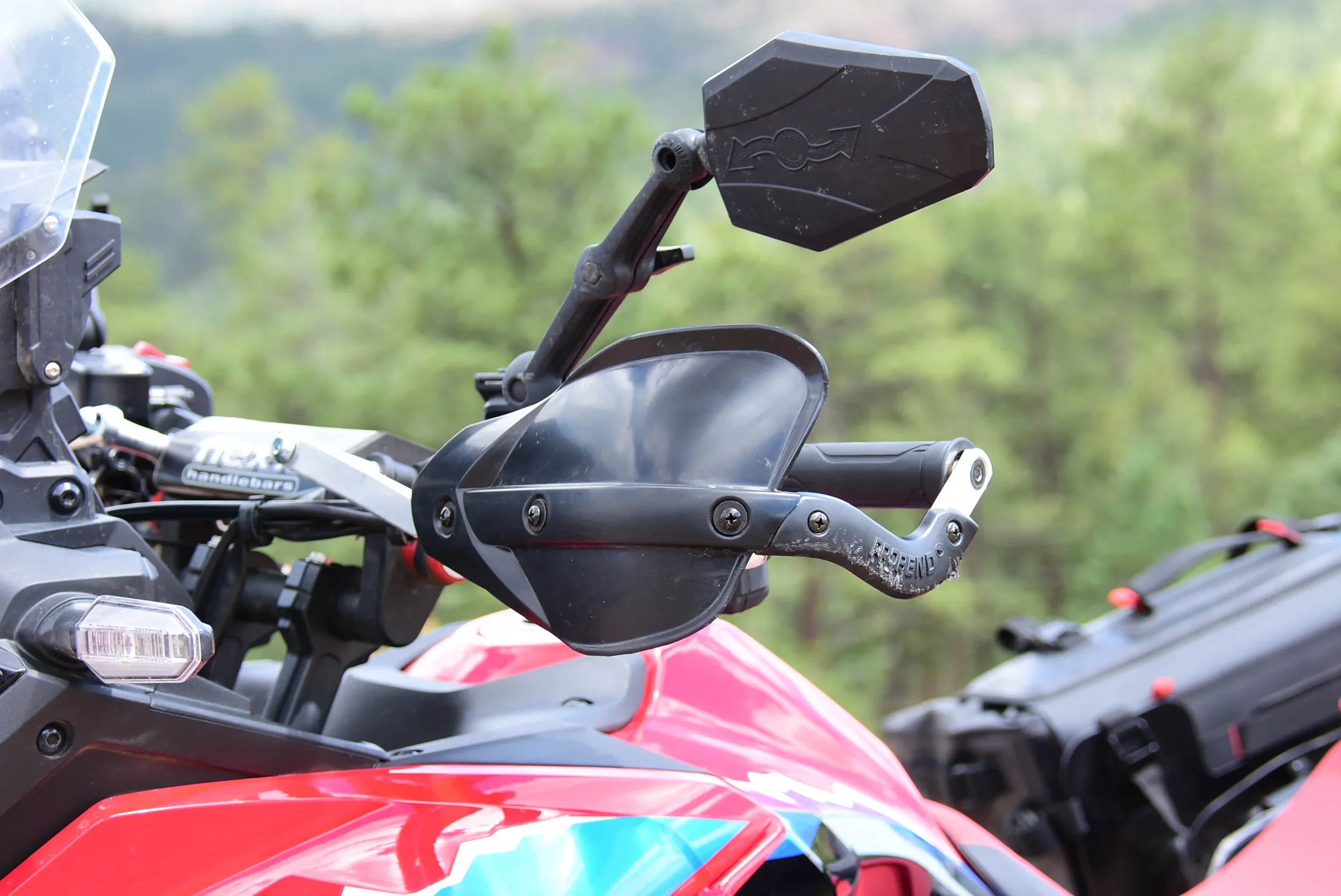
Fasst Company’s Simple Solution Handguards are a full-wrap design to protect the levers in a tipover.
We took an odd route to our solution for improved handguards by installing Fasst Company’s Flexx Adventure Handlebar ($430) and Simple Solution Handguards ($165). Not only did this provide the bike with some burlier bars but really improved the riding position while standing, and the different density elastomers do a good job of sucking up vibration through the bars. The handguards are the full-wrap around style, which will protect your levers in a tipover.
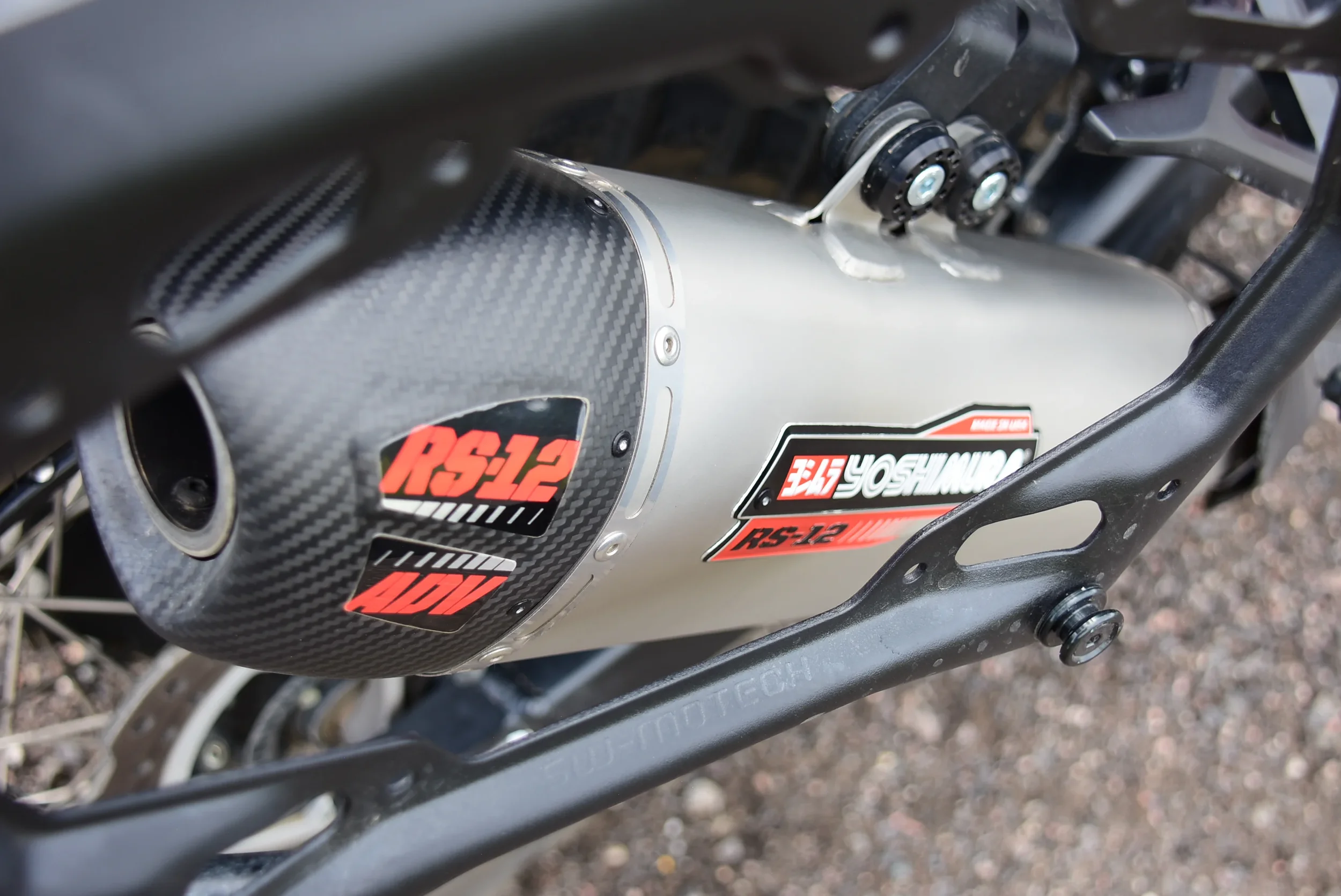
A quick and easy way to cut some weight is swapping out the heavy stock exhaust system with Yoshimura’s RS-12 Stainless Slip-On Exhaust
Sound and Fury
We’re not going to lie, an 1100cc ADV weighing in at 510 pounds with a full tank of fuel is hefty. But a quick and easy way to cut some weight is swapping out the heavy stock exhaust system with Yoshimura’s RS-12 Stainless Slip-On Exhaust ($789). Not only did this save five pounds of overall weight, but that mass was carried up high, which means that in theory it should improve the bikes handling a bit with slightly less mass up top. Sound from the exhaust is now throaty and crisp without being too loud, which is what we were hoping for.
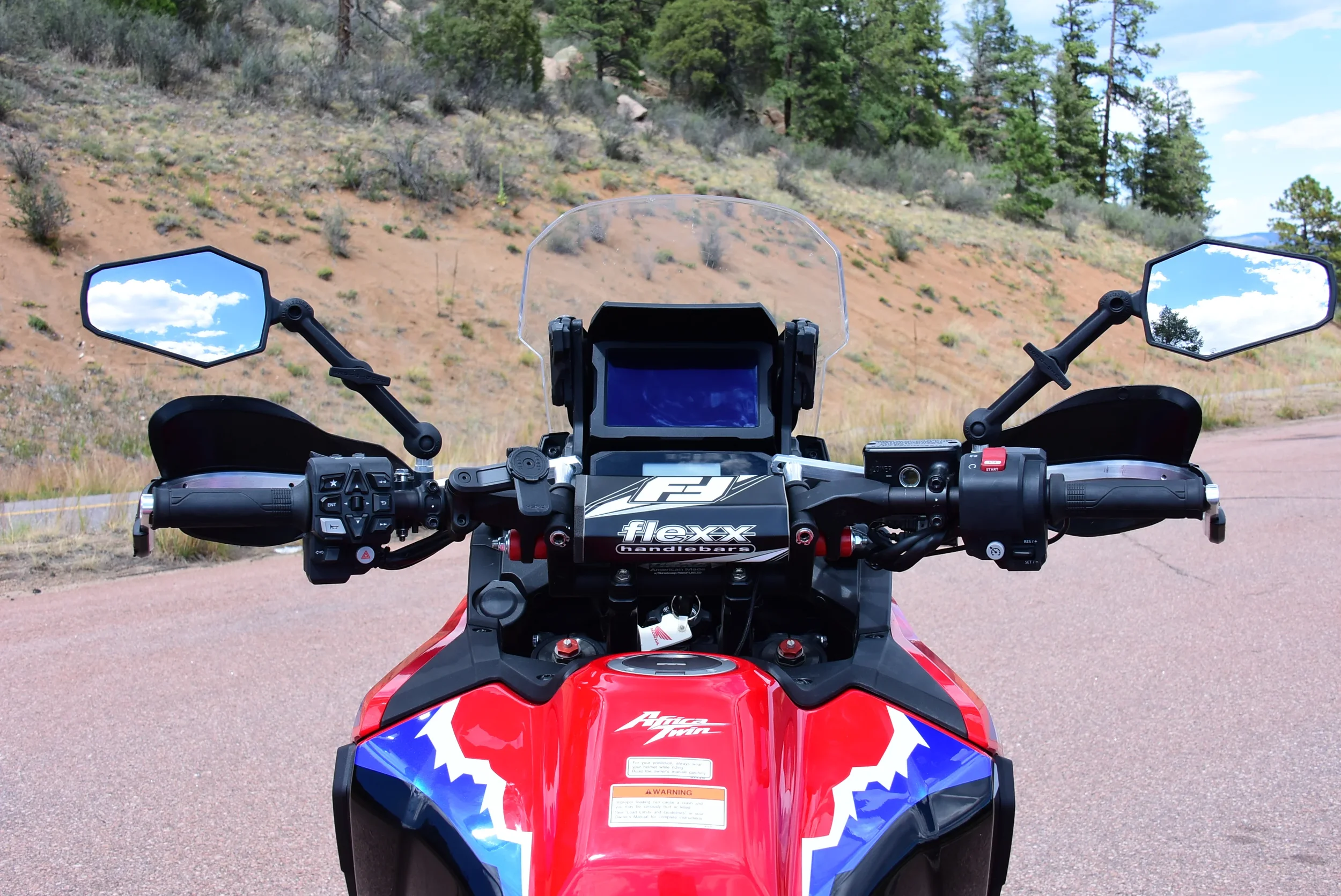
At the heart of our cockpit are the Fasst Company Flexx handlebars. We love the taller position, which is ideal for off-road riding while standing, and really comfortable on road as well.
Cockpit, Comfort, and Convenience
Here is a short list of additional things that we’ll lump into this final category that have made a noticeable difference in transforming our Africa Twin into our ideal budget big-bore ADV. First on that list is one of the most important items that has contributed to rider comfort, and that’s the Honda accessory heated grips ($204). While most of the European ADVs get them standard, you’ll have to order these from the dealer (they were backordered for a long time). Once installed, the grips are easy to use with access via the right bar-mounted function trigger switch and settings displayed on the LCD dash. They offer five levels of heat and have been a big bonus when riding here in the Colorado Rockies.
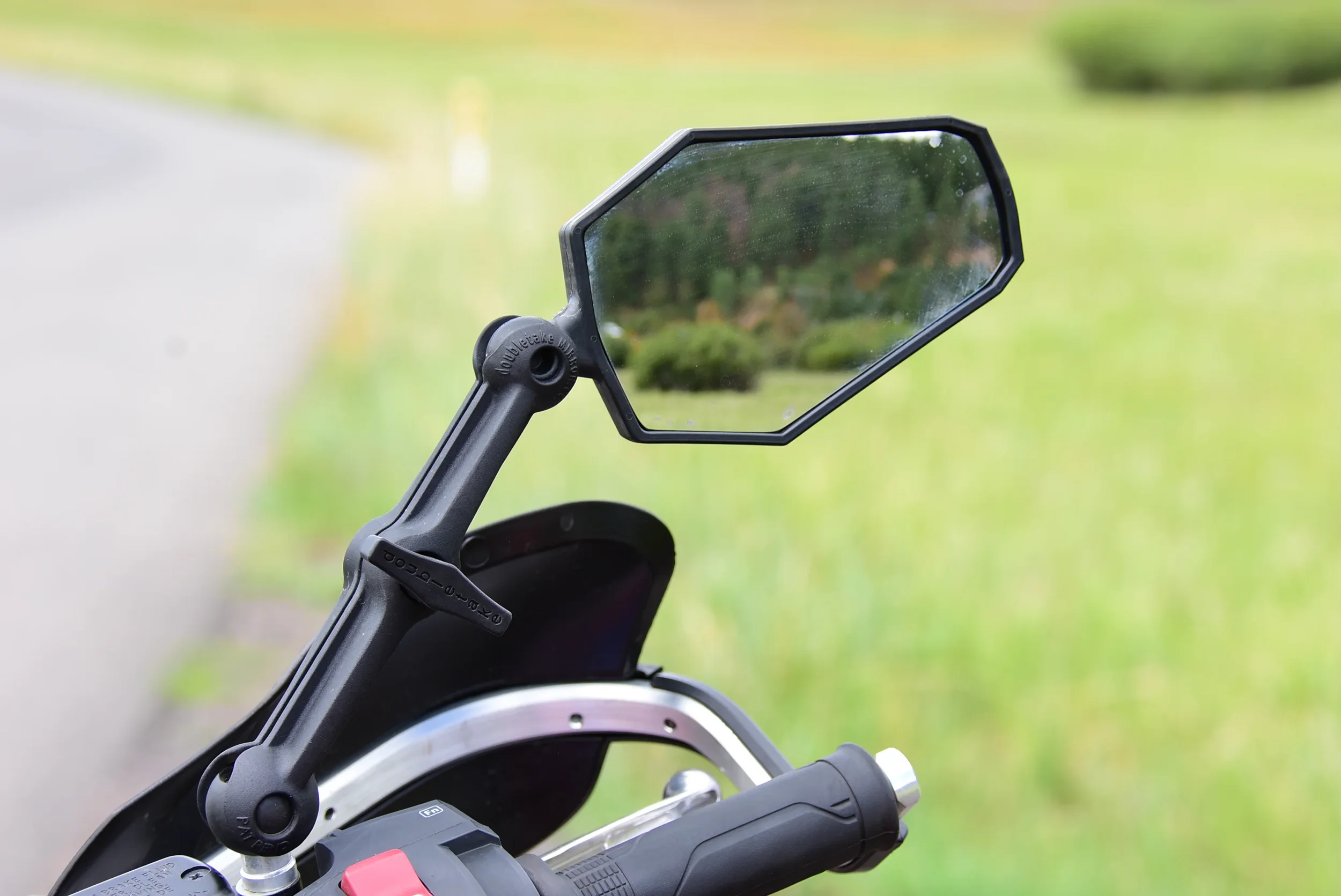
Doubletake’s Adventure mirror is a huge upgrade over the stock mirrors. They are almost infinitely adjustable, and way more durable.
Other cockpit upgrades we’ve made include Doubletake Mirror’s Adventure Mirror Kit ($145), which are a massive improvement compared to the stock Honda mirrors. The Doubletake units offer a massive amount of adjustment and even allow you to fold them completely out of the way for off-road riding, when you don’t want them snagging on tree branches and stuff. They can be easily adjusted on the fly with the oversize thumb nut and provide better rearward view than the stock mirrors.
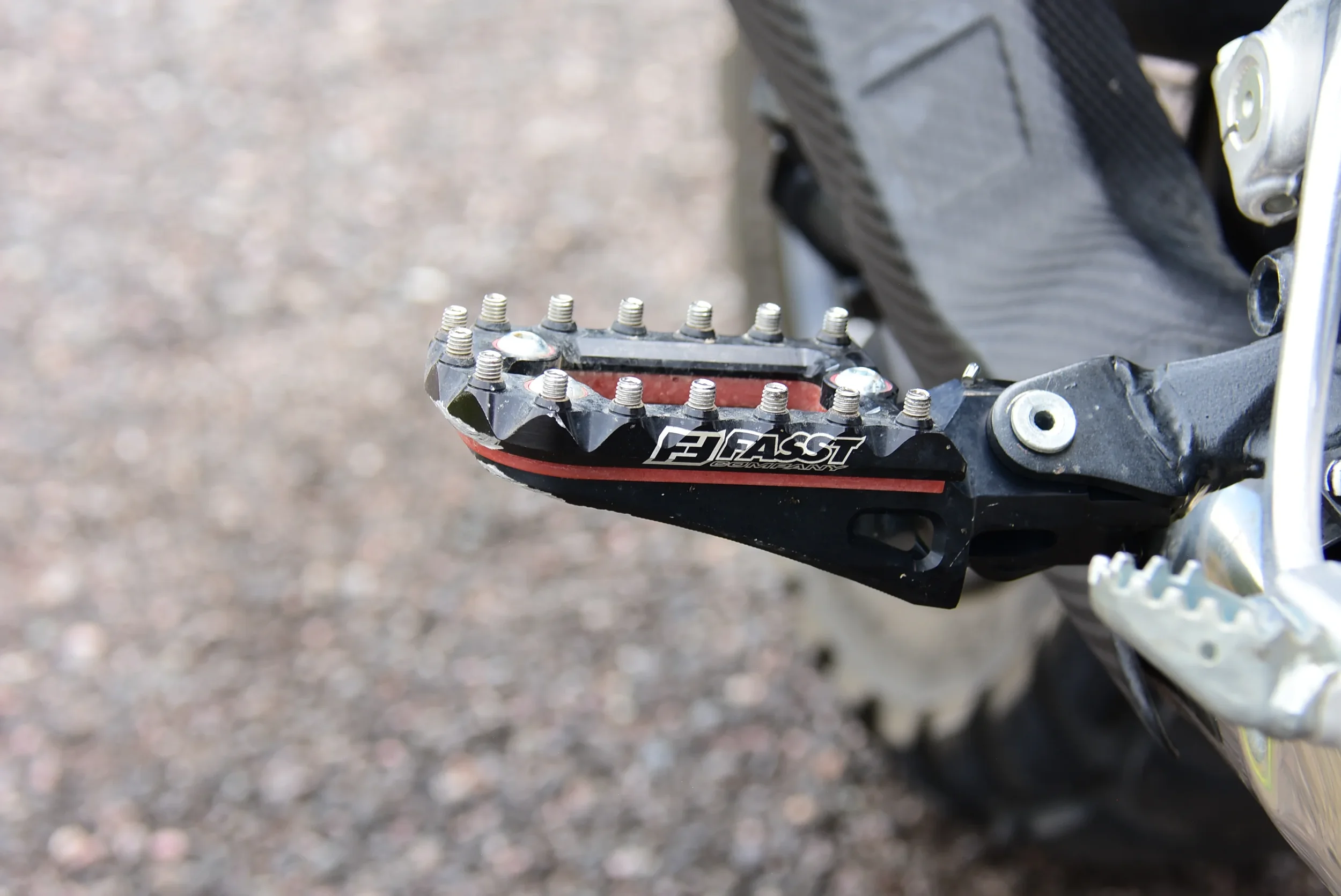
We also replaced the stock footpegs with Fasst Company’s Impact Adventure Footpegs ($260). Not only do these units offer a broader surface but they have a very aggressive array of allen-headed teeth to keep your boots locked in place in every condition from bumpy whoops to water crossings. They also feature a sandwiched elastomer that can be ordered in three different densities for varying levels of vibration absorption. We have been quite happy with their performance, but will warn you not to catch your over-the-boot pants on the teeth and fall over (we’ve managed to do that once!).
Two more items we added include the Honda accessory centerstand ($220) that helps with quick on-the-road chain maintenance, or if you need to plug a tire. The last item on our list is the accessory top-case mount ($237), which at this point we just use for a tie-down location, but could also use with an actual top case if needed.
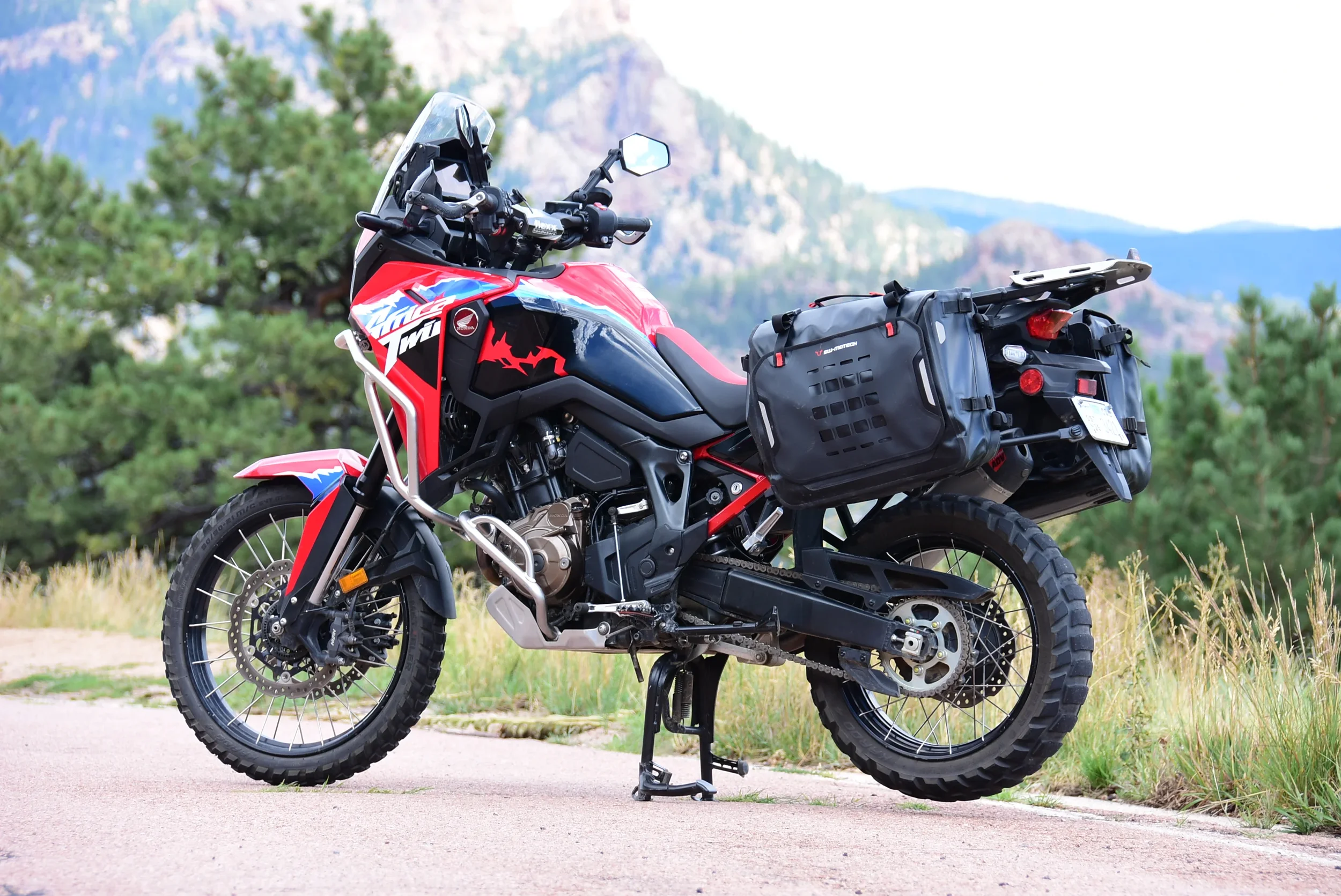
We added Honda’s accessory centerstand for ease of maintenance.
Success?
This project achieved our goal of providing the base-model Africa Twin with some much needed upgrades for touring on and off highway. If we only had to choose a couple items off this list, the luggage, upgraded tires, and heated grips would be mandatory. Not only have we tackled quite a few long trips between Colorado and California on this bike, but we’ve explored gravel and dirt roads all over Colorado, Utah, Nevada, and California. The changes we made improved the bike’s long-distance capabilities, while also making it a much better choice when hitting the dirt. It will never keep up with lighter, mid-sized ADVs off-road, but that wasn’t the point here. For eating up big miles on and off road, our Africa Twin is now just about perfect.